Atradius Atrium
Get direct access to your policy information, credit limit application tools and insights.

 United Kingdom
 Australia
 Austria
 Belgium
 Brazil
 Bulgaria
 Canada
 China
China
 Czech Republic
 Denmark
 Finland
 France
 Germany
 Greece
 Group
Group
 Hong Kong SAR
 Hungary
 India
India
 Ireland
 Italy
Italy
 Japan
Japan
 Lithuania
 Mexico
 Netherlands
 New Zealand
 Norway
 Poland
 Portugal
 Romania
 Singapore
 Slovakia
 Slovenia
 Spain
Spain
 Sweden
 Switzerland
 Turkey
 United Arab Emirates
United Kingdom
United Arab Emirates
United Kingdom
 United States

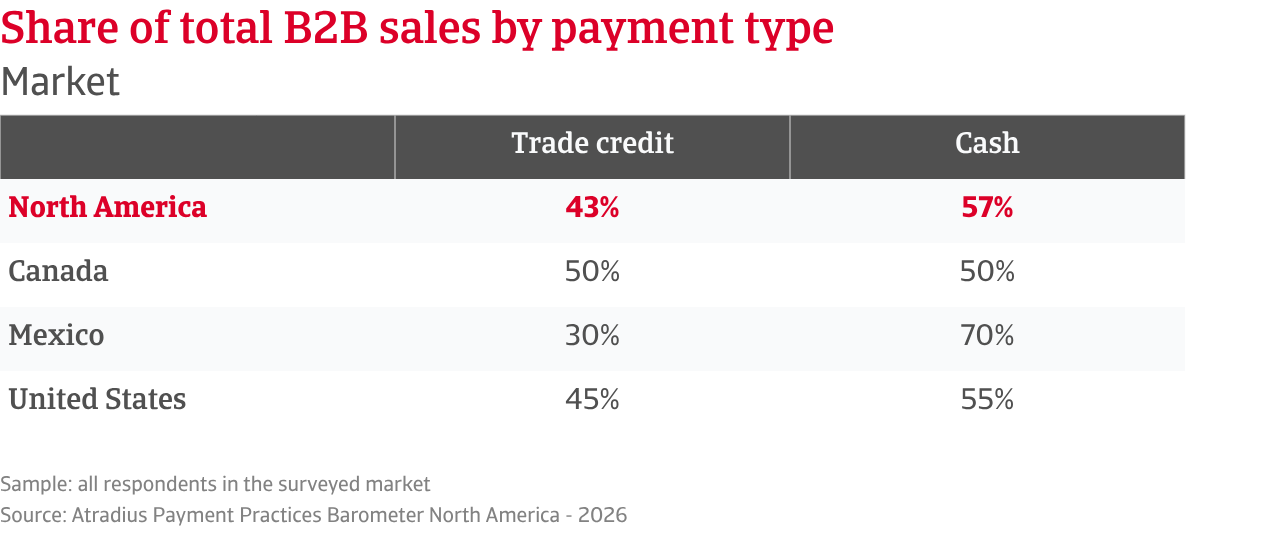
According to our survey data, businesses in North America conduct, on average, 43% of their business-to-business (B2B) sales on credit terms, while the remainder is paid upfront. This balance reflects a cautious but established use of trade credit across the region, where suppliers aim to support sales while maintaining control over cash flow exposure. Across sectors, SMEs are the most likely to extend credit to business customers, often using it as a competitive lever to attract and retain clients in fragmented markets. At country level, Canada shows the highest reliance on trade credit, with around half of sales on deferred terms, followed by the United States at 45%. Mexico records the lowest reliance, at close to 30%, pointing to a stronger preference for upfront payments and tighter credit practices in B2B trade. Trend data confirm that businesses across North America have increased their use of B2B trade credit in recent months, particularly those operating in the manufacturing and trade sectors, where supplier relationships and volume growth often depend on flexible payment arrangements.
B2B trade in North America largely relies on short credit cycles, with limited use of extended payment terms beyond standard practice. Just below three in five businesses across the region report offering B2B payment terms within a standard 30-day credit window, which remains the prevailing structure across the region. Around half extend payment terms to between one and two months, while only very few allow payment periods beyond this threshold. Mid-sized and large manufacturing firms are more likely to rely on longer cycles, reflecting more complex supply chains and larger transaction values. This pattern is most visible among Mexican businesses, where some suppliers adopt extended terms to sustain commercial relationships. Trend data highlight that most North American suppliers have kept payment terms largely unchanged in recent months. Where changes have occurred, they have more often resulted in longer rather than shorter payment terms, particularly among trade companies and businesses in Mexico and the United States.
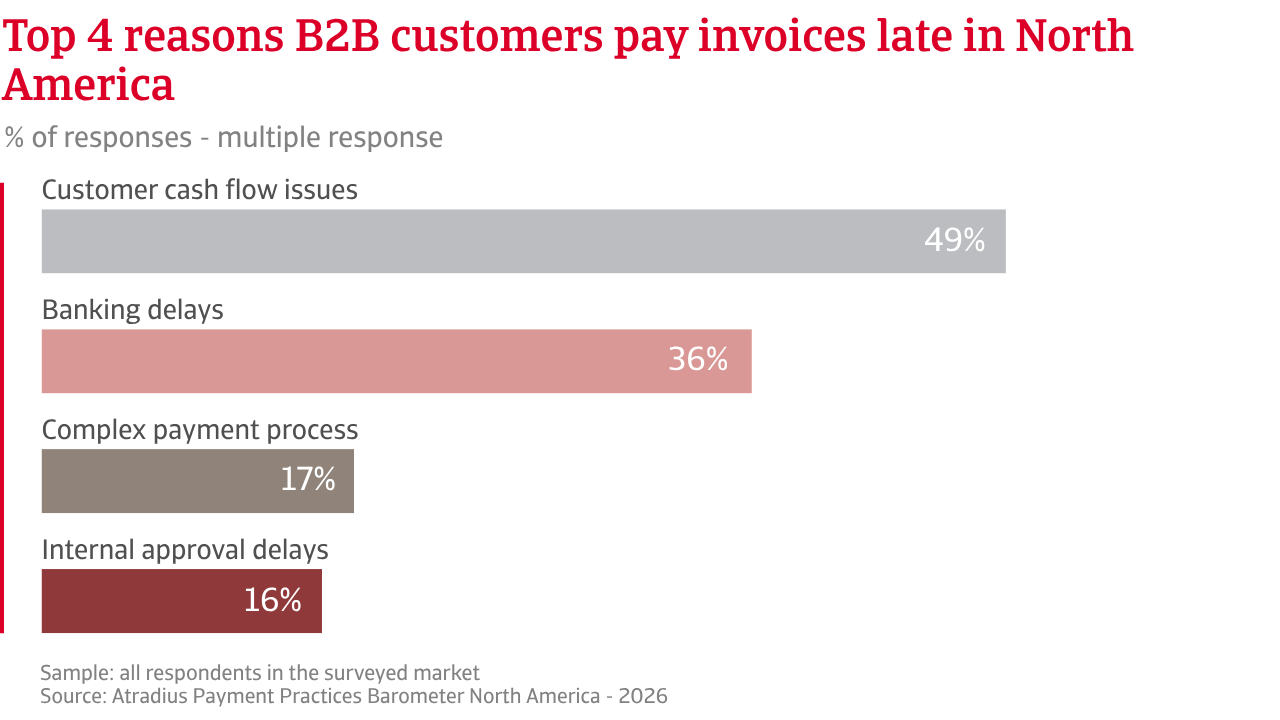
Around half of firms surveyed across the region report no meaningful change in the payment behaviour of business customers in recent months. Where shifts are seen, these tend to be very limited and mainly concentrated among larger firms in trade and construction. Despite this relative stability, delayed payments remain widespread across North American markets surveyed, affecting on average seven in ten firms across the region, particularly mid-sized firms across various sectors and businesses in Canada. These delays impact, on average, 23% of B2B receivables at regional level, placing a measurable strain on working capital cycles. Most suppliers attribute delayed payments primarily to customer liquidity constraints rather than disputes or administrative errors. Operational frictions, including banking delays and internal approval processes, also contribute to slower settlement times, though to a lesser degree.
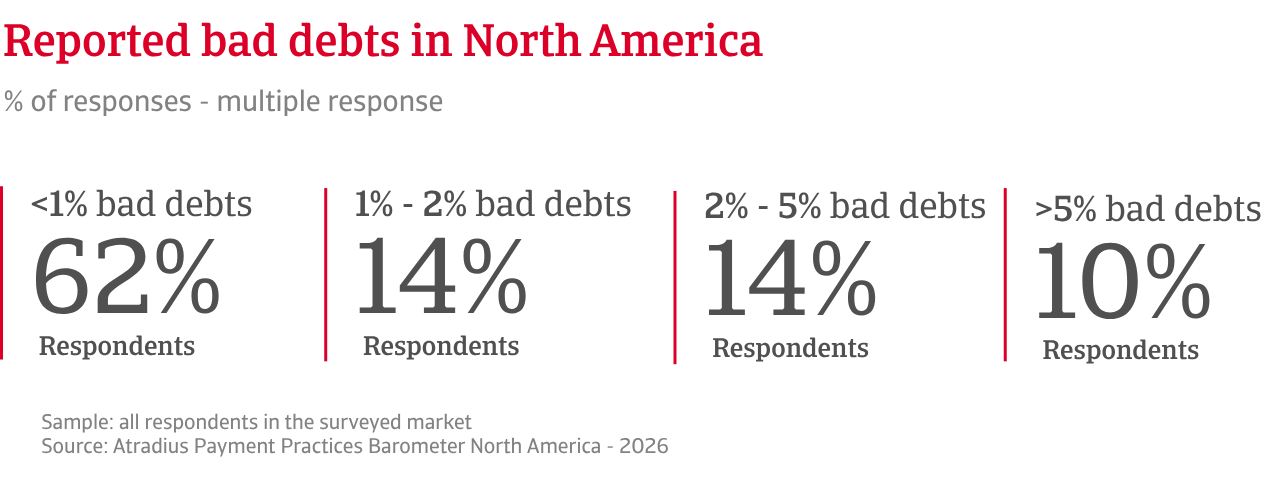
As most overdue B2B receivables are settled within one month of the due date, overall cash conversion cycles among North American suppliers typically extend to around two months from invoicing. This is reflected in data on Days Sales Outstanding (DSO). These settlement times help limit the ageing of receivables and may explain why bad debt is more often linked to customer inactivity or unreachability rather than to prolonged non-payment of large outstanding invoices. Nearly half of North American suppliers report bad debt below 1% of receivables, while fewer than one in four experience levels above 2%. This confirms that bad debt remains broadly contained across the region, although somewhat more pronounced among trade firms and at market level in Mexico.
Survey responses also show that the main impact of B2B customer payment risk on working capital is operational rather than structural. Around one third of suppliers report reduced cash availability, which in turn constrains investment decisions and affects day-to-day liquidity planning. Fewer businesses report higher capital costs or reduced financial flexibility, indicating that most firms absorb payment risk through operational adjustments rather than allowing it to evolve into sustained financial stress. This approach reflects a pragmatic management style where liquidity preservation remains the priority.
The main impact of B2B customer payment risk on working capital is operational rather than structural
In terms of risk mitigation, North American suppliers focus primarily on preventive and operational measures. Many focus on protecting cash flow at the outset of transactions by requesting advance payments or maintaining a share of sales on cash terms. Early payment incentives also play a key role in encouraging faster settlement. More structured risk transfer tools, such as credit insurance and bad debt reserves, are used by around one fifth of businesses, complementing internal credit management practices. More reactive strategies, including legal action or receivables financing, are used far less frequently. This reinforces the view that suppliers aim to address customer payment risk early in the transaction cycle, preventing it from developing into prolonged receivables ageing or broader financial strain.

North America’s economic backdrop remains resilient, but increasingly uneven. Slower growth, tighter financial conditions, and ongoing trade uncertainty appear to weigh on business liquidity. The United States still supports regional activity, while Canada and Mexico face more constrained growth amid ongoing inflation and uncertainty around the USMCA review. In this context, pressure on working capital is building.
However, as survey data show, this has not yet translated into widespread expectations of weaker B2B payment behaviour in the short term. Most sectors and company sizes expect B2B payment behaviour to remain unchanged in the months ahead, particularly among smaller service firms. At the same time, two in five companies anticipate faster payments from business customers, especially in the industrial sector. This suggests a gradual easing of liquidity pressures in more cyclical areas of the economy. Relatively fewer businesses expect customer payment behaviour to worsen, notably medium sized trading firms. Rather than a broad shift, payment risk is becoming more concentrated. Pockets of weakness are emerging, particularly among mid-sized firms and in segments where delays are expected to remain higher than average.
Expectations around insolvency risk reinforce this pattern. Most businesses expect risk to remain above normal levels, reflecting ongoing pressure rather than further sharp deterioration. However, more than one in four companies anticipate a rise in insolvencies, indicating that financial strain is still building in parts of the market. A smaller share remains uncertain, highlighting limited visibility. Profit expectations appear to be positive. Nearly half of businesses across North America expect margins to increase over the next months, while a similar share anticipates no change. Only a limited minority foresee a decline. This points to a broadly supportive profitability outlook, although gains are likely to remain uneven across sectors and firms. In the context of stable payment behaviour and elevated insolvency risk, this underlines a more selective operating environment. Businesses are likely to rely on cost control and pricing discipline to protect margins, even as underlying pressures remain.
.2026-08-31-08-05-43.png)
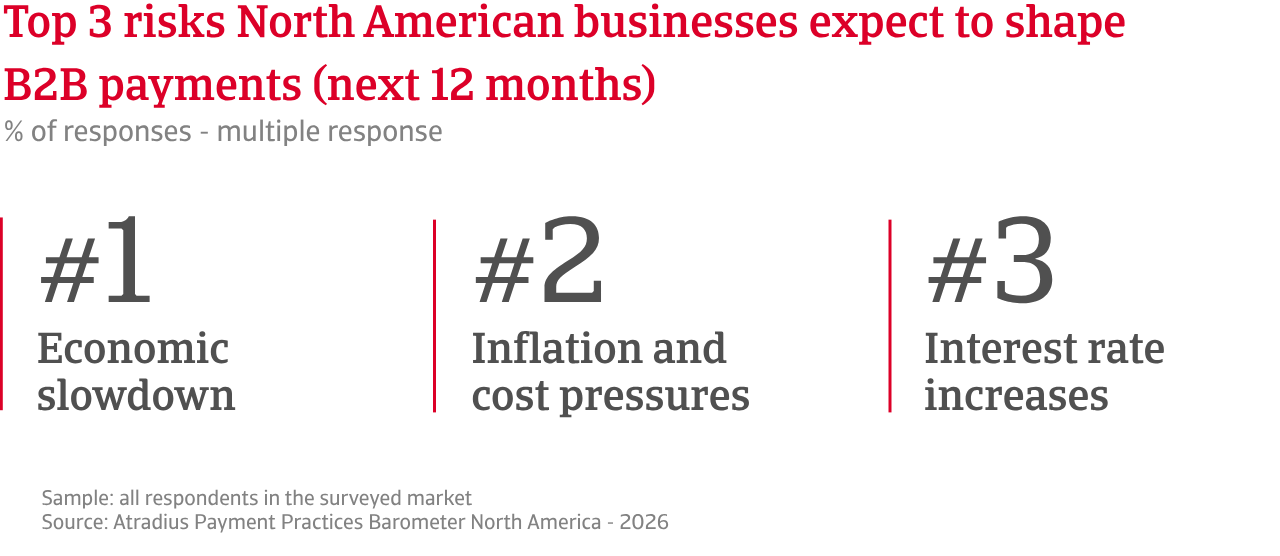
Looking ahead, businesses clearly identify macroeconomic conditions as the main risk to payment behaviour. Economic slowdown leads by a wide margin, followed by inflation and cost pressures. Interest rates also continue to constrain financing and working capital for many firms. Other risks, including geopolitical instability, fraud, and supply chain disruption, play a secondary but still relevant role.
Overall, the findings point to a stable but fragile equilibrium. B2B payment behaviour remains closely tied to broader economic and financial conditions. While headline trends appear stable, underlying vulnerabilities persist. For businesses, this reinforces the need to monitor macroeconomic signals closely and focus on sector and counterparty specific risks.
For a full overview of the 2026 survey results for North America, please download the regional report and the statistical appendix from the related documents section below.
To explore how to strengthen your own credit risk strategy, get in touch with us and see how we can help you stay ahead.