Atradius Atrium
Get direct access to your policy information, credit limit application tools and insights.

 United Kingdom
 Australia
 Austria
 Belgium
 Brazil
 Bulgaria
 Canada
 China
China
 Czech Republic
 Denmark
 Finland
 France
 Germany
 Greece
 Group
Group
 Hong Kong SAR
 Hungary
 India
India
 Ireland
 Italy
Italy
 Japan
Japan
 Lithuania
 Mexico
 Netherlands
 New Zealand
 Norway
 Poland
 Portugal
 Romania
 Singapore
 Slovakia
 Slovenia
 Spain
Spain
 Sweden
 Switzerland
 Turkey
 United Arab Emirates
United Kingdom
United Arab Emirates
United Kingdom
 United States
According to the World Trade Organization (WTO), the trade in goods that are enabling AI (Artificial Intelligence) emerged as the central driver of world trade growth. In 2024, global exports of AI-enabling goods reached USD 3.1 trillion, representing a threefold increase compared with ten years earlier. Trade in AI-enabling goods was responsible for about one-third of global trade growth in 2025.
Currently, the production of key AI hardware and the supply of critical mineral inputs are concentrated in a small number of firms and economies. For example, the firms producing key AI hardware collectively control over 80% of the global AI chip market. AI hardware production is particularly dependent on NVIDIA in the United States, which leads in chip design, ASML in the Netherlands, which produces EUV (extreme ultraviolet) lithography machines, and TSMC in Taiwan, which manufactures the most advanced AI chips.
The scaling of computing capacity, cloud infrastructure and data centres depends on continuous access to raw materials, intermediate inputs and specialised equipment sourced from around the world. At the same time, the concentration of production and supply among a limited number of countries and firms exposes the AI supply chain to disruptions, whether through tariffs, export controls or logistical bottlenecks. As geopolitical tensions rise and governments increasingly use technology policy as a strategic tool, disruptions to AI-related trade flows may become more likely under current geopolitical and policy trends. In this respect, Europe appears relatively weakly positioned between Asia that dominates chip production (Taiwan) and exports of rare earths (China), and the US that controls the software, cloud infrastructure, and chip design. Disruptions to AI supply chains could widen the digital divide between countries at the technological frontier and those that rely on trade to access AI technologies.
Although there is no universally accepted definition of Artificial Intelligence (AI), it is commonly understood as technology that produces outputs, such as recommendations, content or decisions, based on input data, with varying levels of human involvement. Unlike traditional software, these systems can learn from data, adapt their behaviour and evolve over time (see Box: What is AI?).
What is AI?
Artificial intelligence (AI) refers to the science and engineering of building digital systems capable of performing tasks commonly thought to require intelligence, with this behaviour often being learned rather than directly programmed. The three key technical inputs to producing AI capabilities are data, algorithms, and compute, also referred to as the ‘AI triad’. People provide the necessary technical and scientific expertise (human capital) to orchestrate the AI triad in order to produce a trained model.
Data, algorithms, compute and human capital each play a pivotal role in the development and deployment of AI. Data is the raw material that is processed by computing power, or put differently, compute is the ‘engine’ fuelled by large amounts of data. Algorithms dictate the operations that are performed on data to produce AI capabilities. Algorithms are the source code that defines everything from architecture of AI models to the specific methodologies employed in the training. Computing power (and the associated hardware and software) acts as the physical foundation for running AI algorithms. Finally, human capital is important to produce data, algorithms, and computing power and to operate the training process itself.
Most current progress in AI leverages a technology called artificial neural networks. After a neural network model is trained, it becomes capable of executing different tasks, such as writing computer code, generating images, or responding to real-world data.
AI products and services are provided through a complex supply chain. At the base is computing power or specialised hardware, most notably microprocessors and high bandwidth memory chips, as well as the critical mineral inputs required to produce them, designed to handle the intensive computations required for training and running AI models.
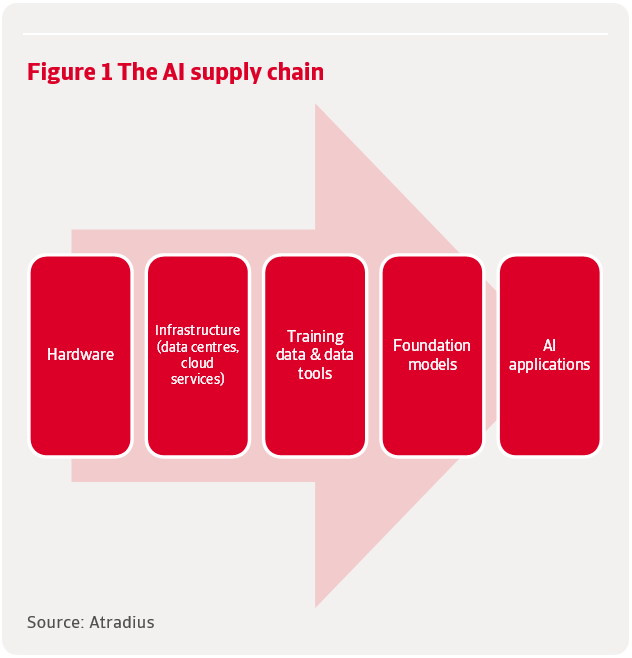
Above hardware sits the infrastructure, including data centres and cloud services, to build, store and operate AI models. The next input layer is training data and data tools. These comprise vast, multimodal data sets spanning text, images, audio and video, sourced from both public and proprietary repositories.
Computing power, cloud infrastructure and data feed into the next layer, the market for foundation models. These are large, pretrained AI models that can be adapted to a wide range of tasks. Finally, the top layer of the supply chain consists of user-facing AI applications that leverage these models for specific uses.
The World Trade Organization (WTO) has published a list of around 100 product codes of ‘AI-enabling’ goods that support the development and production of AI technologies. These AI-enabling goods are divided in three main categories:
Many AI-enabling goods are inherently multi-purpose, covering general IT, computing hardware, and advanced manufacturing components, meaning they have a broader application than just AI development and production. In the remainder of this report, we refer to this list of goods when mentioning AI-enabling goods.
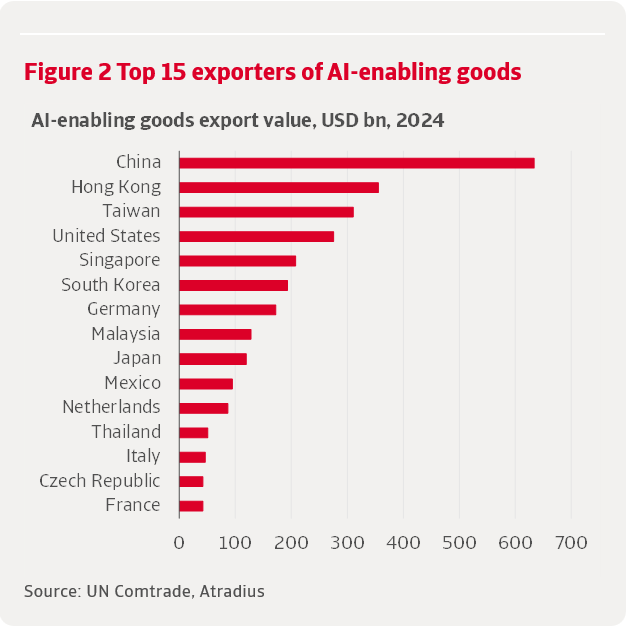
With a 65% share of measured exports of AI-enabling goods, Asian economies play a central role in the global AI supply chain. The largest exporters of AI-enabling goods are located in East Asia, particularly China, Hong Kong, Taiwan, Singapore and South Korea (figure 2). Countries in North America and Europe that play an important role in AI goods exports include the United States, Germany and the Netherlands.
Despite the relatively small size of its economy, the Netherlands ranks as the world's eleventh-largest exporter of AI-enabling goods in value terms. The most valuable AI-enabling export product of the Netherlands is semiconductor manufacturing equipment, which is domestically produced by ASML.
Globally, in export value terms, intermediate inputs (USD 2.4 trillion) and AI equipment (USD 721 billion) dominate. By contrast, raw materials and processed chemicals account for a much smaller export value (USD 48 billion).
In the categories analysed, exports are highly concentrated across the AI-enabling goods supply chain, with the 15 largest exporters accounting for 85% to 90% of global exports in each category.
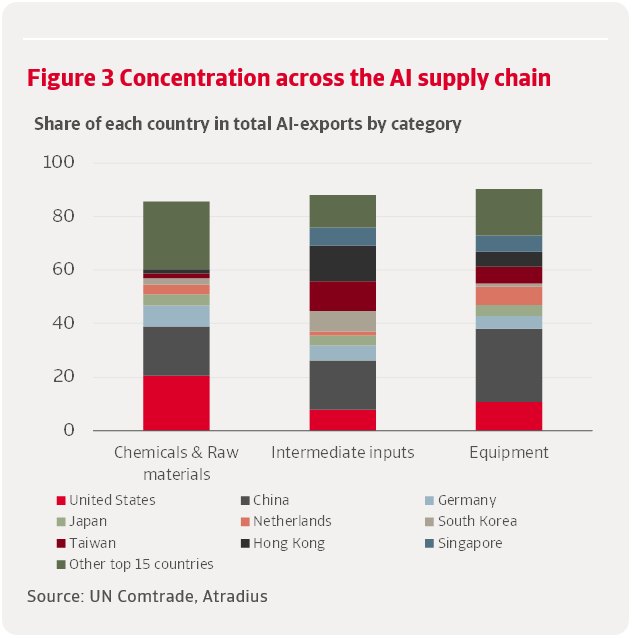
Moreover, concentration even rises slightly as one moves up the supply chain. This is an indication that more technologically sophisticated activities are undertaken by, if anything, even a smaller number of economies (figure 3).
Asian economies play a particularly prominent role in intermediate inputs and equipment, accounting for 70% and 58% of global exports, respectively. China alone represents 18% of intermediate input exports and 27% of equipment exports. It is also the only Asian economy with a substantial share of chemicals and raw materials exports, accounting for 18% of the global total in this category.
Countries in North America and Europe, perhaps surprisingly, have the largest footprint in the exports of raw materials and chemicals. They account for more than half (55%) of exports in this category, with the United States alone representing 21% of the total. This does not alter the fact that Asian economies, particularly China, continue to occupy an important position in the supply of raw materials that are critical to the AI supply chain, even where these account for a relatively low nominal export value, such as gallium, germanium and silicon carbide. In the other two categories, intermediate inputs and equipment, countries in North America and Europe play a much less prominent role, accounting for roughly one quarter of global exports in each category. As an exception, the Netherlands, despite its relatively small economy, accounts for 7% of global AI equipment exports.
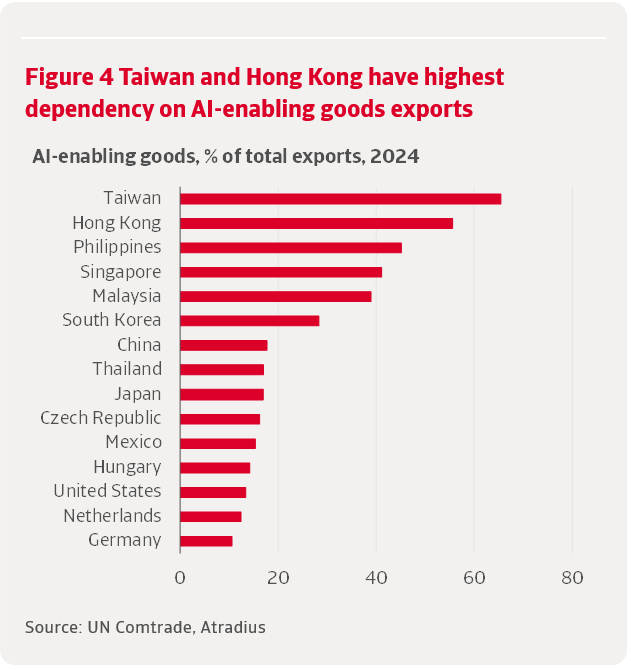
The exposure to AI-enabling exports is very high in certain economies that take a dominant role in the AI supply chain. Taiwan and Hong Kong are most exposed, with 65% and 56% of exports consisting of AI-enabling goods. These countries are followed by the Philippines (45%), Singapore (41%) and Malaysia (39%). In contrast, export concentration is much more moderate in China (18%) and the US (13%).
The total export value of raw materials and chemicals that are related to AI was USD 48 billion in 2024. The product codes with the highest export value in the raw materials and chemicals category were:
Together, these three product codes have a total export value of USD 27 billion, or 56% the total export value in this category. Acyclic ethers and their derivatives (USD 11 billion) serve as a vital chemical building block for the manufacture of advanced semiconductor microchips that power AI. The main exporters of this specific product are China, the US, Saudi Arabia and the Netherlands. Unwrought or powder palladium (USD 9 billion) provides critical corrosion and oxidation resistance as protective plating on semiconductors and forms the durable metal connections that attach compact AI chips to circuit boards. Large exporters of this commodity are the US, South Africa and the UK. Silicones in primary forms (USD 7 billion) serve as critical thermal management and packaging materials that protect and cool completed AI microchips. China, the US and Japan are major exporters of this commodity.
For most exporters of raw materials and chemicals, this category makes up an insignificant part of total goods export value. The only exception is South Africa, where this category represents 2.4% of total goods export, reflecting its role as a major exporter of palladium.
Intermediate inputs consist of processed or partially manufactured goods used in semiconductor production. The top three products in this category all fall under electronic integrated circuits:
These three products combined represent USD 995 billion in export value, or 42% of total export value in this category. Countries in East Asia heavily dominate the exports of intermediate inputs used in AI development. Processors and controllers (USD 376 billion) are essential components enabling data processing and computation in AI systems. These include electronic integrated circuits that are used in graphics processing units (GPUs) to train large-scale AI models. The main exporters of this product are Hong Kong, Singapore and China. Other electronic integrated circuits (USD 365 billion) include essential components in AI hardware for data storage, processing, and communication functions. These include specialised networking and power chips that allow increasingly complex AI clusters to operate efficiently by facilitating high-speed data exchange and power distribution. Trade of this product is heavily concentrated, with Taiwan accounting for the largest share of exports (27% of the global total), followed by Hong Kong and Singapore. Memories (USD 254 billion) are used to continuously feed data to the GPU, preventing localised memory latency and processing idle time during AI model training. The largest exporters of memories are South Korea, China and Hong Kong.
Intermediate inputs make up a significant share of total goods exports across Asia. For Hong Kong and Taiwan, intermediate inputs account for around 50% of total goods exports of these countries. Malaysia (33%), Singapore (32%) and South Korea (26%) also have a high export dependency of intermediate inputs used in the AI supply chain.
AI equipment covers the specialised tools and machines used in AI development and deployment. The main products in this category by export value are:
These three product codes represent a combined export value of USD 453 billion, or 63% in this category. Communication devices (USD 178 billion), such as network switches and routers, cover essential machines for AI systems that rely on high-speed data exchange, cloud computing and connected devices. Major exporters of this product are China, the US, Hong Kong, the Netherlands and Mexico. Portable automatic data processing machines (USD 146 billion) include, for example, laptops and tablets. These devices serve as platforms for developing, testing or running lightweight AI models locally, and accessing AI tools and performing computations. China accounts for a very large share of global exports of this product, with an export value of USD 102 billion. Automatic data processing machines (USD 129 billion), such as servers and motherboards, are the tools and equipment used for the design, verification, optimization, debugging and testing of semiconductors.
AI-enabling equipment can make up a significant portion of total goods exports, although it is not as significant in value as intermediate inputs. Relative to total exports, Taiwan (9%), Mexico (8%), Thailand (7%) and the Netherlands (7%) stand out as having a relatively high dependency on AI equipment exports. The Netherlands is a major re-exporter of communication devices, such as network switches and routers. It is also a major exporter of domestically produced semiconductor manufacturing equipment. This reflects the presence of ASML, the world’s sole supplier of EUV lithography machines used to produce the most advanced AI chips.
AI hardware is produced using an extremely concentrated supply chain. The large majority of the world’s most advanced AI chips are manufactured by a single company (Taiwanese TSMC), which is critically reliant on EUV lithography machines, also only manufactured by a single company (Dutch ASML). Several other links in the supply chain are also dominated by a few providers, including data centre GPU design (where the American multinational, NVIDIA, has a market share of over 80%, and cloud compute services (dominated by a few large providers).
The extraction and processing of critical raw materials such as gallium, germanium, and rare earth elements, which are essential for high-performance semiconductors and AI accelerators, are also highly concentrated in a handful of economies. For example, the production of palladium, a precious metal used in semiconductor manufacturing and packaging, is heavily concentrated in just two countries: Russia and South Africa. These two countries are estimated to account for roughly 80-90% of global supply.
Similarly, germanium and high-purity silicon are critical inputs for the semiconductor ‘front-end’ (wafer fabrication) and have very few alternative sources, meaning that a trade disruption in these products could have a rapid impact on AI chip production. Currently, China dominates the production of gallium and germanium, while the production of high-purity silicon is led by Germany, the US and Japan.
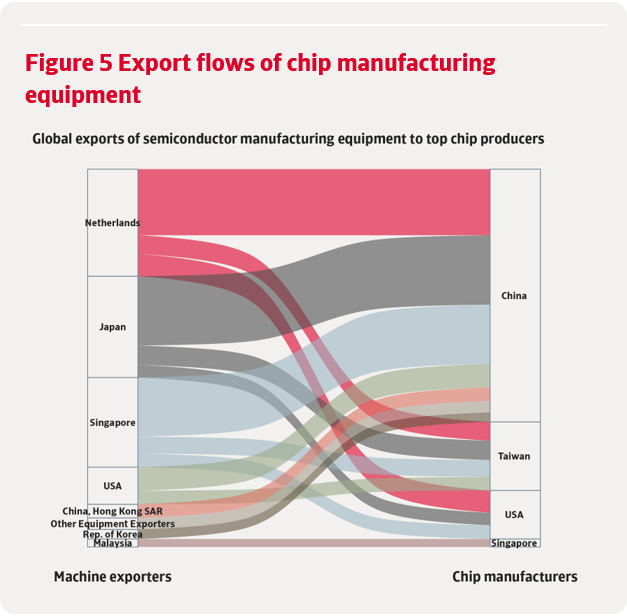
We illustrate this concentration in the AI supply chain with two examples. The first focuses on semiconductor manufacturing equipment. The second examines the chips themselves, specifically the most advanced processors used to train AI models, commonly known as graphics processing units (GPUs).
HS code 848620 is the globally standardised commodity code for machines and apparatus used solely or principally to manufacture semiconductor devices. The largest global exporter in this product code is the Netherlands. The Netherlands is home to ASML, the only company in the world currently capable of producing EUV lithography machines. These machines are essential for making the most advanced AI chips (like those designed by NVIDIA). Other major exporters in this HS code are Japan, Singapore and the United States. However, these countries do not produce the most advanced EUV lithography machines. Figure 5 shows how the exports of chip manufacturing equipment is distributed over the major chip exporting countries.
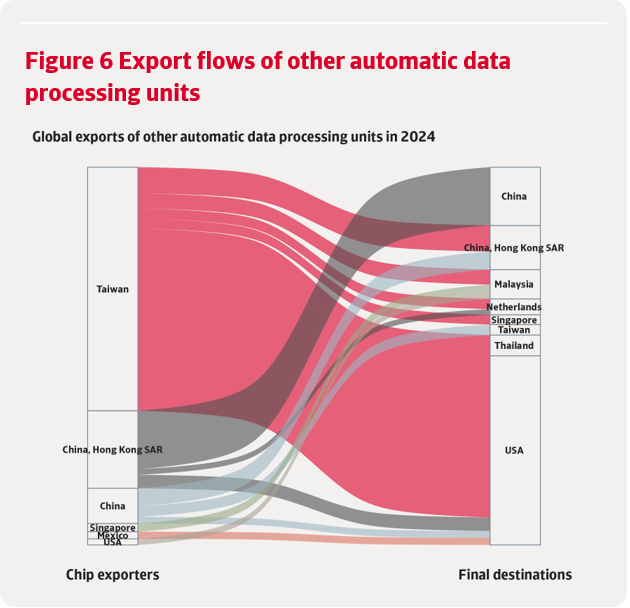
In the past couple of years there has been astronomical growth in demand for AI chips. These chips are overwhelmingly designed by NVIDIA, which has a market share of over 80%, and are manufactured in Taiwan. Taiwan classifies the GPUs that are used to train AI models under HS code 847180. An analysis of the leading exporters within this product code indicates that Taiwan accounts for a very large share of this market segment. The primary export destination is the United States, where the majority of global data centres and artificial intelligence training facilities are concentrated (figure 6). A well-documented administrative mismatch is that the United States classifies incoming standalone GPUs under code 847330, meaning that the exact same trade flow is reported under different product codes by Taiwan and the United States.
As AI adoption expands across the economy, demand for the goods and inputs that enable AI is growing rapidly. While the supply chain of AI products is complex and global, a select number of countries manage to dominate each stage of the supply chain. The top 15 exporters account for 85% to 90% of global exports in each major step of the AI supply chain. For certain critical raw materials, chip manufacturing equipment and the most advanced AI chips, concentration can increase even beyond this. Using two examples of such highly concentrated supply chains, we showed that for some critical goods just a handful of countries account for nearly all global supply. This market concentration underscores the vulnerability of the global AI supply chain for trade disruptions.