Atradius Atrium
Get direct access to your policy information, credit limit application tools and insights.

 United Kingdom
 Australia
 Austria
 Belgium
 Brazil
 Bulgaria
 Canada
 China
 Czech Republic
 Denmark
 Finland
 France
 Germany
 Greece
 Group
 Hong Kong SAR
 Hungary
 India
 Ireland
 Italy
 Japan
 Lithuania
 Mexico
 Netherlands
 New Zealand
 Norway
 Poland
 Portugal
 Romania
 Singapore
 Slovakia
 Slovenia
 Spain
 Sweden
 Switzerland
 Turkey
 United Arab Emirates
United Kingdom
 United States
The consumer durables sector currently faces pressure from an uncertain and volatile global economy, characterised by geopolitical tensions and fragmented trade. The current conflict in the Gulf has amplified uncertainty in global energy markets and driven up energy, transport and food prices. Global consumer price inflation is expected to exceed 4% in 2026 and 2027, and price growth remains sufficiently high across many markets to continue eroding purchasing power. At the same time, slower hiring activity and moderating wage gains across major economies are expected to weigh on household income growth into 2027, limiting the pace of consumer spending recovery. The sustained energy supply shock coupled with the long period of above-target core inflation has pushed central banks towards hiking rates, constraining the borrowing capacity of consumers and businesses.
As a result of all this, many consumers remain cautious and are focusing their spending on essential goods and services, lowering discretionary spending and postponing or avoiding big-ticket item purchases. Next to lower sales prospects, consumer durables producers and retailers are currently facing higher input costs for energy and certain commodities.
Rising global trade barriers remain a key risk. Higher US tariffs on China, India and parts of Europe are affecting supply chains for consumer durables, increasing business costs and adding to price pressures for consumers. If operating costs rise substantially, retailers may feel forced to modify their sourcing policies and look for new partners to dodge tariff hikes. Many could seek to pass on charges to customers by raising prices to protect their margins.
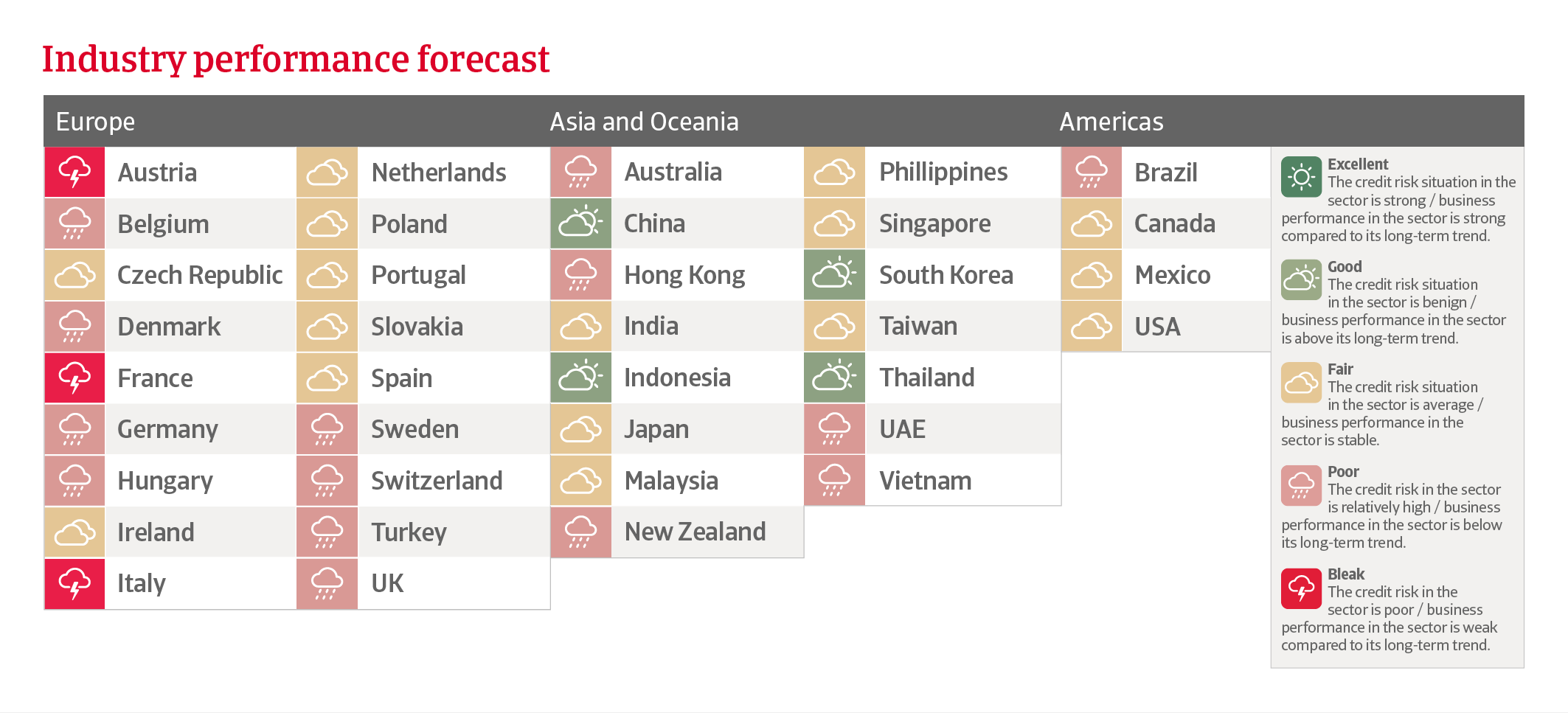
Businesses selling higher-value discretionary products remain particularly exposed to cautious consumer spending, including areas such as furniture, home furnishings and major domestic appliances. The credit risk of consumer durables retailers in many advanced markets remains elevated, with smaller players especially vulnerable to defaults and insolvency. The sector operates in a fiercely competitive environment with thin margins. These are being further squeezed by more frequent markdowns, as consumers seek discounts year-round, and particularly so in the current situation.
At the same time, online retailers are increasing their market share, putting pressure on brick-and-mortar operators. Large companies with ample cash reserves will be best positioned to navigate the stormy waters. In general, strong cash generation, avoidance of excess inventories and the ability to keep investing in stores, customer experience and online are helping retailers withstand pressure better than others.

US consumers remain worried about high gasoline prices and the broader inflationary impacts of the US-Iran war. Elevated inflation and higher borrowing costs due to Fed rate hikes will weigh on household spending at the end of 2026 and through 2027. After increasing 3.3% in 2025, US retail sales growth in real terms is expected to slow down to 1.9% in 2026 and 1.7% in 2027. While 2026 festive holiday season retail sales are forecast to increase by 2.2% in volume, this rise is less than would be seen in a typical year.
The squeeze in real incomes and consumer spending mainly affects lower- and middle-income households, who spend a larger share of their income on gasoline. In contrast, high-income households will sustain spending for consumer goods, helped by asset price gains this year. Discretionary spending and demand for durable goods are the most exposed to the current developments, as big-ticket purchases are typically deferred when energy prices, inflation and uncertainty rise. Shoppers are getting more price-sensitive and focused on value. Retailers have responded by extending promotional events, expanding private-label offerings, and highlighting value-focused product bundles.
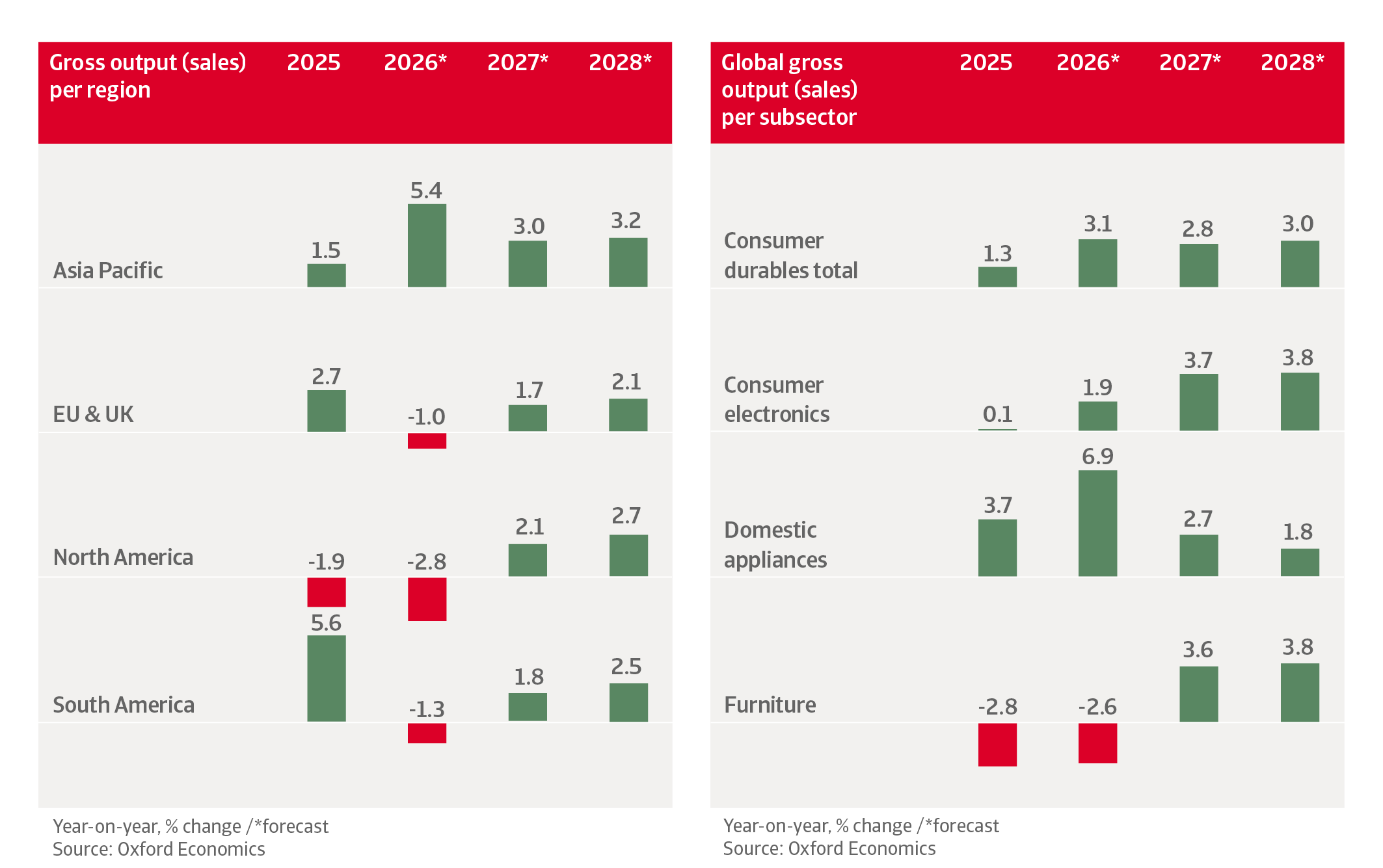
We expect the gross output of US consumer durables to increase by 2.4% next year, a rise mainly due to gradual disinflation and recovery in spending taking effect in H2 of 2027. Domestic appliance and furniture sales should grow by 1.8% and 3.1% respectively after steep contractions in 2026. Consumer electronics is expected to rebound at 5.8% next year.
Brick-and-mortar retailers are continuing to lose market share to ecommerce. Online purchasing will account for 19.3% of total consumer goods spending in 2027, up from 16.4% in 2025, as households favour the price transparency and convenience of digital channels. Traditional retailers are increasingly adopting digital strategies to remain competitive, further driving the growth of online retail.
The brick-and-mortar segment remains vulnerable to bankruptcies due to increased supply chain and inventory challenges, as well as the current concerns over household spending power. Business revenues have declined when adjusted for inflation. Smaller and price-driven operators will struggle to absorb higher costs, price wars and regulatory complexity. These developments are expected to continue driving insolvency levels higher in the coming months.
Before the imposition of tariffs, the US had sourced a large proportion of its domestic appliances, consumer electronics, and furniture from Asia, in particular China. The tariffs have not led to a reshoring of consumer durables production in the US. While imports from China have decreased, these have shifted to other countries including Mexico and Vietnam. A few US producers have gained higher pricing power, but at the same time tariffs have increased input costs for domestic manufacturers (e.g. for metals). In general, the options to reshore the production of consumer durables are limited, as US manufacturers lack the infrastructure and specialised skills to ramp up large-scale output in the short term, while labour costs are also an issue.

Chinese retail sales are expected to grow by 0.6% in 2026 and 1.5% in 2027, while consumer durables gross value growth is forecast to slow from 5.7% this year to 2.9% in 2027. Higher energy prices linked to the US-Iran conflict, weak wage growth and increased unemployment are exerting pressure on household purchasing power. Issues in the property sector are ongoing, where home buyers are confronted with negative wealth effects due to price pressures. Chinese households have considerable exposure to the real estate sector as their main channel of wealth creation. All this is impeding higher consumer spending, in particular for big-ticket items. Additionally, the boost from government support measures and an expanded trade-in scheme for durable goods like household appliances and consumer electronics has faded.
The retail market in China is currently the second-largest consumer market globally. Online retail sales of physical goods continue to outpace offline growth, with instant retail (30-minute to 1-hour delivery) emerging as a key driver. When consumers do spend, they are increasingly trading down, with ecommerce platforms competing hard on price. Major online platforms are expanding their low-margin but high-frequency sales patterns. As customer acquisition costs rise and discounting remains widespread, smaller players face increasing pressure, supporting further market consolidation. Future sales growth potential for consumer durables lies with Tier II and Tier III cities and rural areas, where improvements in logistics infrastructure and digital connectivity are expanding the online consumer base.
Chinese furniture manufacturing is expected to contract by 4.4% in 2026 after a 6.4% decrease in 2025. Property market issues and US tariffs continue to weigh on exports of home goods. This has prompted Chinese factories to cut shifts, reduce wages, and relocate some production to Southeast Asia. With domestic demand subdued due to the weak housing performance, producers are left with little capacity to offset the external weakness. That said, in 2027 a rebound of more than 4% is on the cards, partly compensating for the downturn seen over the past two years.

Real household spending in Japan is expected to grow by just 0.7% in 2026 before slowing further to 0.6% in 2027. Consumers are facing sticky inflationary pressures due to high food and energy costs. Consumer prices in Japan are expected to increase to 2.8% in 2027 from 1.9% this year, hitting disposable household incomes. Consumer confidence remains below pre-pandemic levels, pointing to continued caution towards large discretionary purchases. We expect consumer durables output in Japan to grow by just 1.5% in 2027, with subdued sales in particular of big-ticket items. In the long run, the ageing and declining population size will mean weaker consumption prospects.

French household consumption has remained slightly positive so far in 2026, increasing by 0.3% year-on-year in volume over the first nine months. However, the outlook is highly uncertain. Higher energy prices are squeezing household real incomes and constraining discretionary spending. Consumer confidence remains below its long-term average, reflecting persistent political instability, uncertainty about future tax increases, and a deteriorating labour market. French consumers will remain price-sensitive towards the end of 2026 and in 2027; seeking to trade down to lower price points, with a reduced spending appetite for bigger purchases and non-essentials.
Credit risk in the retail segment remains elevated. Inventories are quite high due to low levels of demand, and financial partners are increasingly restrictive with short-term facilities. Margins are generally low across all subsectors, but higher in the small household appliances segment compared to consumer electronics. The level of payment delays and insolvencies remains high among smaller retailers. While large, specialised retailers generally benefit from scale and stronger market position, financial vulnerability can also affect major players, particularly when weak demand combines with high fixed costs, operational difficulties and liquidity pressure. Several prominent French consumer durables retailers entered insolvency proceedings this year.

We expect retail sales growth in Germany to slow down to 0.6% in 2026, with a modest rebound of 1.5% predicted for 2027. Consumer durables gross output will show only modest growth of about 1% annually. Private consumption is a weak spot in the German economy. Consumer sentiment has deteriorated due to the US war with Iran, as fuel prices have sharply increased, eroding purchasing power. Inflation is currently expected to average 2.7% this year and 2.8% in 2027. Unemployment has risen in recent months, and ongoing industrial job losses are additionally weighing on consumer confidence. All this is impeding spending, in particular for discretionary items. Many consumers are trading down, postponing purchases until sales and avoiding impulse buys.
This hits a sector that has already struggled with higher credit risk over the past couple of years. Consumer durables producers and retailers are suffering with high input costs, in particular for energy, expensive credit and thin margins. The level of payment delays and insolvencies has been elevated in 2025 and 2026, and we expect further increases in the coming months. This is affecting the retail segment in particular.

The quite robust consumer spending seen in H1 this year has started to slow down, mainly due to increased energy prices. High inflation, expected to peak above 4% in Q4 this year and Q1 next year, is now curbing household purchasing power. This will have a dampening effect on the sales growth of consumer durables during the upcoming festive holiday season and into next year. In 2027 private consumption growth is forecast to slow down to 0.6% from 1.1% this year. The inflationary shock impacts wages, which in real terms are much lower than before Covid. Monetary tightening will raise debt repayment costs for Italian consumers, impacting spending appetite. Compared to 2019, 2027 household purchasing power will be just 1% higher, with retail sales volumes 3% lower.
After decreases of more than 5% in each segment this year, gross output of consumer durables in Italy will remain subdued in 2027. Domestic appliances and consumer electronics are forecast to see 0.9% and 0.2% contractions respectively. Furniture growth is expected to level off.
Price sensitivity prevails among consumers, driving a strong preference for cheaper consumer products, particularly through ecommerce channels. Online retail is increasingly diverting market share from brick-and-mortar retailers. Currently small independent retailers are particularly vulnerable. Next to lower demand they face higher energy and wage costs, increased working-capital requirements, inventory risk and weaker bargaining power.

Despite some underlying weakness in the Spanish retail sector, triggered mainly by geopolitical uncertainty in the Middle East, the overall outlook for consumer durables sales remains positive. Private consumption is expected to grow by 3% this year and by 2% in 2027. Macroeconomic tailwinds reinforce Spain's position as the eurozone outperformer, with rising disposable incomes and ongoing job creation fuelling greater discretionary spending. While inflation has increased in recent months and will remain elevated in H1 of 2027, so far households have been able to navigate through more elevated price levels due to higher income growth and stronger purchasing power.
We expect Spanish retail sales and consumer durables gross output to increase by 2.1% and 2.7% respectively in 2027. Domestic appliances will benefit from rising demand for energy efficiency items and furniture from home renovation. However, persistently high energy prices caused by a protraction of the US-Iran conflict remain a downside risk for discretionary spending, in particular big-ticket items. Credit risk in the sector is above average for smaller independent retailers with weak online capabilities, limited purchasing scale and high inventories.

We expect UK private consumption growth to slow down to 0.3% next year after growing 1.2% in 2026. After decreasing by 0.4% this year, consumer durables gross output is forecast to contract by 0.7% in 2027, mainly due to declines in the domestic appliances and furniture segments. British consumers have adopted a more cautious, wait-and-see approach and are deferring major purchases as uncertainty persists. High inflation of more than 3% will cause real incomes to fall next year. The combination of elevated oil and gas prices and subdued pay growth are squeezing household spending power. At the same time tighter financial conditions are pushing up interest rates paid by households and businesses. With the UK’s public finances under strain, recently announced government support to ease the cost of living is small-scale and temporary.
All this places significant pressure on businesses reliant on big-ticket discretionary spend. Next to subdued demand, consumer durables producers and retailers are facing mounting cost pressures from higher energy prices and increases in National Living Wage and National Insurance contributions. This makes it even more difficult to preserve adequate profit margins, in particular for the retail segment.
Credit risk in the sector remains high, and it is important that businesses focus on disciplined working capital and liquidity management if they are to succeed. Smaller retailers are struggling most in the shrinking market, as many are unable to access more favourable pricing and payment terms. Businesses that have invested well over the last few years in blending online and in-store shopping experiences for consumers are better off.
Download the full report in the related documents section below.
To explore how to strengthen your own credit risk strategy, get in touch with us and see how we can help you stay ahead.